
Search Engine Marketing
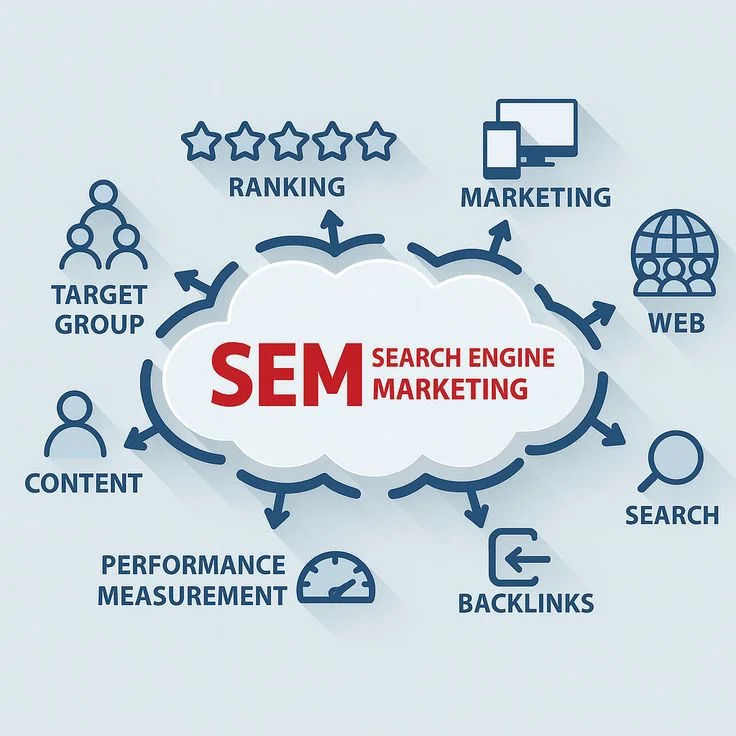
What is Search Engine Marketing?
Search Engine Marketing (SEM) is a digital marketing strategy that improves a website’s visibility on search engine results pages through paid advertising campaigns. It involves keyword targeting, ad creation, bidding strategies and campaign optimisation to reach potential customers.
Meaning of Search Engine Marketing
Search Engine Marketing (SEM) is one of the most effective digital marketing strategies used by businesses to increase their online visibility, attract potential customers, generate website traffic, and improve sales through search engine advertising. It is a paid digital marketing approach that allows businesses to display their advertisements on search engine results pages (SERPs) when users search for specific products, services, or information related to their business. Search Engine Marketing mainly focuses on paid advertising platforms such as Google Ads and Microsoft Advertising, where advertisers compete to display their advertisements for relevant search queries by selecting suitable keywords, creating engaging advertisements, setting advertising budgets, and targeting specific audiences. Unlike traditional advertising methods, SEM allows businesses to reach people who are already searching for products or services, making it easier to connect with users who have a higher possibility of becoming customers.
Keyword Research in SEM
One of the most important elements of Search Engine Marketing is keyword research, which involves identifying the search terms and phrases that potential customers use when looking for particular products or services online. Selecting the right keywords helps advertisers display their advertisements to relevant audiences and avoid spending money on unnecessary clicks. Keywords can be classified into different match types, including broad match, phrase match, and exact match, which control how closely a user’s search query needs to match the selected keyword before an advertisement becomes eligible to appear. Advertisers can also use negative keywords to prevent their advertisements from appearing for irrelevant searches, helping them improve campaign performance and control advertising expenses.
Pay-Per-Click (PPC) Advertising
Another important component of SEM is Pay-Per-Click (PPC) advertising, where advertisers generally pay whenever someone clicks on their advertisement rather than simply viewing it. Google Ads is one of the most widely used platforms for implementing SEM campaigns because it provides different advertising formats, including search ads, display ads, shopping ads, video ads, and performance-focused campaigns. Search advertisements usually appear above or below organic search results and contain headlines, descriptions, display URLs, and additional information such as call extensions, sitelinks, and other assets that encourage users to visit a website or contact a business.
Google Ads Auction System
Google Ads uses an auction system to determine which advertisements appear for a particular search query, and the position of an advertisement is influenced by factors such as the advertiser’s bid, ad quality, expected click-through rate, advertisement relevance, and landing page experience. Quality Score is an important diagnostic tool in Google Ads that helps advertisers understand the quality and relevance of their keywords, advertisements, and landing pages. Improving advertisement relevance and providing useful landing page content can help businesses achieve better advertising performance and potentially reduce their cost per click.
Audience Targeting in SEM
SEM also provides advanced audience targeting options that allow advertisers to reach potential customers based on their geographical location, language, demographics, interests, search behaviour, and other available targeting signals. For example, a digital marketing freelancer in Ernakulam can create a Google Search campaign targeting people searching for digital marketing services, SEO services, social media marketing, website development, and Google Ads management within specific geographical areas. This approach helps businesses focus their advertising budgets on audiences who are more likely to require their products or services instead of showing advertisements to a broad and unrelated audience.
Budget Management and Bidding Strategies
Budget management and bidding strategies are also essential parts of Search Engine Marketing because they determine how much a business is willing to spend to generate clicks, leads, website visits, or conversions. Advertisers can choose different bidding strategies, such as manual cost-per-click bidding, maximise clicks, maximise conversions, target cost per acquisition, and target return on ad spend, depending on their campaign objectives and available performance data.
Search Engine Marketing Campaign Management
Effective SEM campaign management involves planning, creating, monitoring, and optimising advertisements to achieve specific marketing objectives. Advertisers need to select suitable campaign types, organise relevant keywords into ad groups, write compelling advertisement copy, configure targeting settings, and establish appropriate budgets. Regular campaign monitoring helps marketers identify which advertisements are performing well and which areas require improvement. Businesses can also modify their campaigns based on customer behaviour, advertising costs, competitor activities, and changing marketing requirements.
Conversion Tracking in SEM
Conversion tracking is another important feature that helps businesses measure the actual results generated through their advertisements, such as website purchases, contact form submissions, phone calls, newsletter registrations, and other valuable customer actions. By analysing conversion data, marketers can understand which keywords, advertisements, audiences, and campaigns are generating the best results and make necessary adjustments to improve overall performance.
Important SEM Performance Metrics
Several important performance metrics are used to evaluate SEM campaigns, including impressions, clicks, click-through rate (CTR), cost per click (CPC), conversion rate, cost per acquisition (CPA), and return on ad spend (ROAS). Impressions indicate how many times an advertisement has been displayed, while clicks represent the number of times users interact with it. Click-through rate measures the percentage of impressions that result in clicks, helping advertisers understand how effectively their advertisements attract attention. Cost per click indicates the average amount paid for each advertisement click, whereas conversion rate measures the percentage of visitors who complete a desired action after interacting with an advertisement. Cost per acquisition helps businesses understand how much they spend to acquire a customer or generate a conversion, while return on ad spend measures the revenue generated compared with the amount invested in advertising. These metrics provide valuable insights into campaign performance and help marketers identify opportunities for improvement.
Advertisement Copywriting and A/B Testing
A/B testing is another useful technique in SEM that involves comparing different advertisement headlines, descriptions, calls to action, and landing page elements to identify which versions perform better. For example, a business can test two different search advertisements promoting the same service to understand which message generates a higher click-through rate or conversion rate. Creating attractive advertisement headlines, relevant descriptions, and clear calls to action can encourage users to interact with advertisements and visit business websites.
Landing Page Optimisation
Landing page optimisation also plays an important role in campaign success because users who click on advertisements should be directed to relevant, informative, mobile-friendly, and easy-to-navigate web pages that clearly communicate the offered products or services. A well-designed landing page should include a strong headline, relevant content, clear service information, attractive visuals, customer testimonials where available, and a visible call-to-action button that encourages visitors to take the next step. A relevant landing page experience can improve user engagement and increase the possibility of converting website visitors into customers.
Looking for a Digital Marketing Freelancer in Ernakulam? Adwaith Ashok offers Search Engine Optimisation, Social Media Managing & Social Media Marketing, Content Marketing, PPC, WordPress Web Design & Development, Email Marketing and More.
Advantages of Search Engine Marketing
One of the major advantages of Search Engine Marketing is its ability to deliver measurable and relatively immediate results compared with many traditional marketing methods. Once a campaign is properly configured and approved, advertisements can begin appearing for relevant searches, allowing businesses to generate website traffic and potential leads without waiting for long-term organic search rankings. SEM also provides flexibility because advertisers can adjust campaign budgets, pause advertisements, modify keywords, test different advertisement variations, and change targeting settings whenever necessary.
Another significant advantage is precise audience targeting, which helps businesses connect with people who are actively interested in their products or services. SEM provides measurable results, allowing advertisers to track clicks, conversions, advertising expenses, and revenue. It also supports brand awareness, lead generation, website traffic, customer acquisition, and online sales. Businesses of different sizes can use flexible advertising budgets to promote their products and services according to their marketing objectives.
Challenges of Search Engine Marketing
Search Engine Marketing also has certain challenges that businesses need to consider before investing in paid advertising. One of the major challenges is advertising cost, especially in highly competitive industries where multiple businesses compete for the same valuable keywords. Popular commercial keywords can have higher cost-per-click rates, making it difficult for businesses with limited budgets to compete effectively. Another challenge is that website traffic and lead generation may decrease when advertising campaigns are paused or when the available budget is exhausted.
Poor keyword selection, irrelevant advertisements, weak landing pages, incorrect audience targeting, and ineffective bidding strategies can also result in unnecessary advertising expenses and lower conversion rates. Additionally, businesses need to continuously monitor their campaigns because changes in customer behaviour, competitor activities, keyword demand, and advertising platform features can influence campaign performance over time.
SEM Campaign Monitoring and Optimisation
Search Engine Marketing should be treated as an ongoing optimisation process rather than a one-time advertising activity. Businesses should regularly review search terms, identify irrelevant queries, update negative keyword lists, analyse conversion performance, test new advertisement variations, and adjust bidding strategies according to their marketing objectives. Monitoring campaign performance helps marketers identify areas that require improvement and ensures that advertising budgets are used effectively. Regular optimisation can also improve advertisement relevance, attract more qualified visitors, and increase the chances of generating conversions.
Difference Between SEO and SEM
It is also important to understand the relationship between Search Engine Marketing and Search Engine Optimisation (SEO), as both strategies help businesses improve their visibility on search engine results pages but work in different ways. SEO focuses on improving organic search rankings through website optimisation, high-quality content, technical improvements, and relevant backlinks, whereas SEM focuses on paid advertisements that allow businesses to appear in sponsored search results. Combining SEO and SEM can create a stronger search marketing strategy because paid advertisements can generate immediate visibility while SEO helps build long-term organic traffic and online authority.
Types of Search Engine Marketing Advertisements
Businesses can use different advertising formats to reach their target audiences depending on their products, services, and campaign objectives. Search ads appear in search engine results when users search for relevant keywords. Display ads use images, banners, and other visual elements to promote products and services across websites and applications. Shopping ads showcase products with images, prices, product names, and merchant information, making them useful for e-commerce businesses. Video ads allow brands to promote their products and services through video content on platforms such as YouTube. These advertising formats provide businesses with different opportunities to increase brand visibility, attract customers, and generate sales.
Local Search Engine Marketing
For local businesses, location-based targeting can help attract customers who are searching for nearby services. Businesses can target specific cities, towns, regions, or service areas to reach potential customers within their preferred geographical locations. For example, a digital marketing agency can target people searching for SEO services, website development, and social media marketing within its operating area. Local SEM campaigns help businesses reduce irrelevant traffic and focus their advertising budgets on audiences who are more likely to become customers.
Role of SEM in Digital Marketing
Furthermore, SEM enables businesses of different sizes to compete in the digital marketplace by providing flexible advertising budgets, measurable campaign objectives, and precise targeting options. Small businesses, startups, freelancers, local service providers, e-commerce stores, and large organisations can all use search engine advertising to reach their target audiences and promote their offerings. Businesses can also use insights from paid search campaigns to identify valuable keywords, understand customer search intent, and discover which advertising messages attract the most attention, which can support their broader SEO and content marketing activities.