
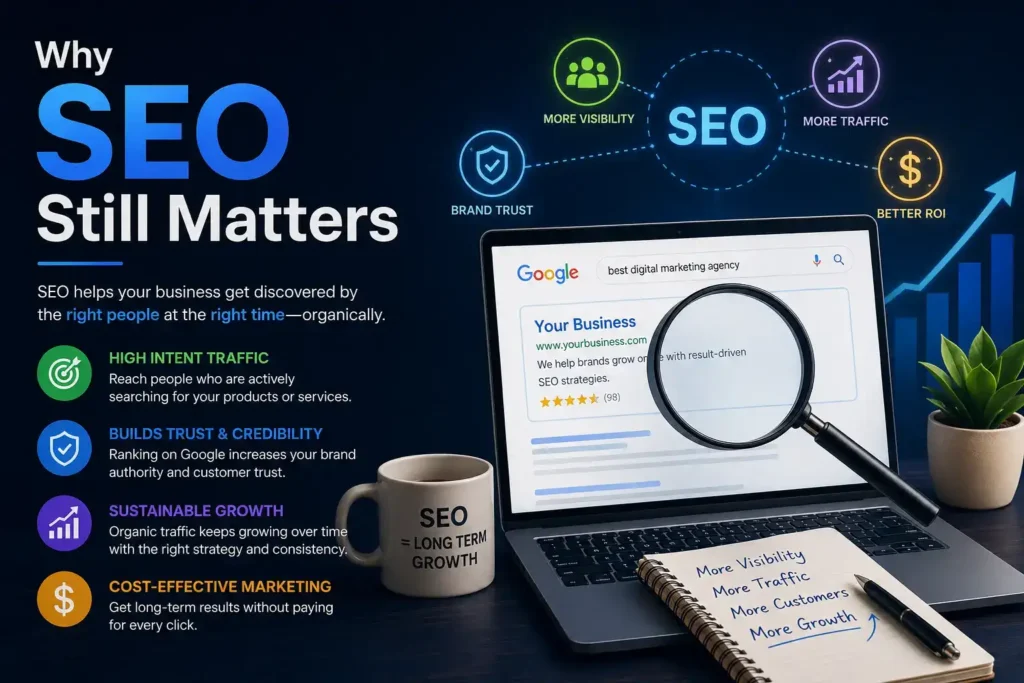
Why SEO Still Matters in the Ever-Changing Digital Landscape
Introduction
Having a website is no longer enough to guarantee online visibility. Millions of websites compete for attention every day, and even an excellent website can remain unnoticed if potential customers cannot find it. This is where Search Engine Optimization (SEO) plays a crucial role.
SEO helps businesses become visible when potential customers are actively searching for information, products, or services related to their needs. Unlike marketing methods that interrupt users while they are engaged in other activities, SEO connects businesses with people who already have an interest or intent to find a solution.
For example, a website may have an attractive design, valuable products, and high-quality services but still receive very little traffic. An SEO audit may reveal problems such as poor keyword targeting, technical issues, slow loading speeds, weak content, or ineffective website structure. Identifying and addressing these issues can significantly improve a website’s visibility and ability to attract relevant visitors.
SEO Builds Sustainable Organic Visibility
One of the greatest advantages of SEO is its ability to build long-term organic visibility. Paid advertising can provide immediate exposure, but it requires continuous financial investment. Once an advertising campaign ends or the budget runs out, the visibility generated by those advertisements can disappear.
SEO works differently. High-quality content and a well-optimized website can continue attracting relevant organic traffic long after the initial work has been completed. This makes SEO a valuable long-term digital asset for businesses seeking sustainable growth.
However, SEO should not be viewed as a quick marketing technique that produces overnight results. Building organic visibility requires consistency, patience, quality content, technical optimization, and continuous adaptation to changes in search behavior and algorithms.
SEO Improves User Experience and Builds Trust
Modern SEO goes beyond keywords and search rankings. Search engines increasingly evaluate factors such as website speed, mobile responsiveness, navigation, content quality, accessibility, security, and overall user experience.
Optimizing these elements benefits both search engines and website visitors. A fast, mobile-friendly, easy-to-navigate website creates a smoother experience and reduces the chances of visitors leaving because of frustration.
Organic search visibility can also contribute to brand credibility. Users often associate strong organic search positions with relevance, authority, and trustworthiness. When a business consistently provides useful and reliable information, it can establish itself as a trusted source within its industry.
SEO Connects Businesses With Customer Intent
A major strength of SEO is its connection to search intent. People use search engines to solve problems, answer questions, compare products, research services, and make purchasing decisions.
A strong SEO strategy focuses on understanding what users are actually looking for rather than simply targeting individual keywords. Businesses can create content that addresses different stages of the customer journey.
For example, a potential customer might first discover a brand through an informational search, return later to compare different solutions, and eventually search specifically for the brand before making a purchase. By providing valuable content throughout this journey, businesses can remain visible at multiple stages of the decision-making process.
The Importance of Local SEO
SEO is particularly valuable for businesses that depend on customers in specific geographic locations. People frequently search for nearby restaurants, stores, professionals, service providers, and other businesses.
Local SEO helps businesses improve their visibility for location-based searches by optimizing business information, location-specific content, reviews, and other online presence factors.
When done effectively, local SEO can help a business appear at the right time when potential customers are actively searching for a nearby solution. This makes it an important strategy for businesses that rely on local customers and physical locations.
SEO Supports the Entire Digital Marketing Strategy
SEO should not operate independently from other digital marketing activities. High-quality SEO content can support social media marketing, email marketing, paid advertising, content marketing, and brand-building campaigns.
For example, a well-researched blog article can be transformed into social media posts, email content, videos, advertisements, or other marketing materials. This allows businesses to gain greater value from the content they create.
SEO can also provide valuable insights into customer behavior. Keyword research and search data reveal the questions, challenges, interests, and needs of potential customers. These insights can influence website content, advertising messages, social media strategies, product development, and broader marketing decisions.
Technical SEO Remains Essential
Even the best content may struggle to perform if a website has serious technical problems. Search engines need to be able to crawl, understand, and index a website effectively.
Technical SEO includes areas such as:
- Website speed and performance
- Mobile usability
- Website security
- Internal linking
- Site structure
- Accessibility
- Crawlability and indexability
- Structured data
- Page organization and navigation
Addressing these technical elements creates a stronger foundation for both search visibility and user experience. Businesses should therefore consider technical SEO an ongoing part of maintaining a healthy digital presence.
SEO in the Age of Artificial Intelligence
The rise of artificial intelligence and generative search is changing how people discover information online. However, this does not mean SEO is becoming irrelevant. Instead, SEO is evolving.
Modern search systems increasingly rely on semantic understanding, structured information, content quality, authority, relevance, and context. AI-powered search experiences also need reliable and well-structured information to understand businesses and their content.
As search continues to evolve, businesses should focus less on manipulating individual rankings and more on becoming reliable sources of useful information within their industries. Strong SEO fundamentals can help brands remain discoverable across traditional search engines as well as emerging AI-driven discovery platforms.
SEO Is a Long-Term Business Strategy
SEO should be viewed as a strategic investment rather than a temporary marketing campaign. Search algorithms, technologies, customer behavior, and competitors constantly change, which means SEO requires ongoing monitoring and improvement.
Businesses that consistently publish useful content, maintain technical website health, understand their customers, and adapt to changes in search can build stronger organic visibility over time.
The goal should not simply be to rank for as many keywords as possible. Instead, businesses should aim to provide the most useful and relevant experience for the people they want to reach.
Conclusion
SEO remains one of the most important components of modern digital marketing because it connects businesses with customers at the moment they are actively searching for information, products, and services.
Its value extends far beyond rankings. Effective SEO can improve organic visibility, strengthen credibility, enhance user experience, generate valuable customer insights, support other marketing channels, and create long-term business opportunities.
As search engines become more sophisticated and AI continues to transform online discovery, SEO will continue to evolve. Businesses that focus on high-quality content, search intent, technical performance, user experience, authority, and genuine customer value will be better positioned to remain visible in an increasingly competitive digital landscape.
Ultimately, SEO is not simply about getting a website to appear higher in search results. It is about helping the right people discover the right information at the right moment—and turning that visibility into lasting trust, engagement, and business growth.