
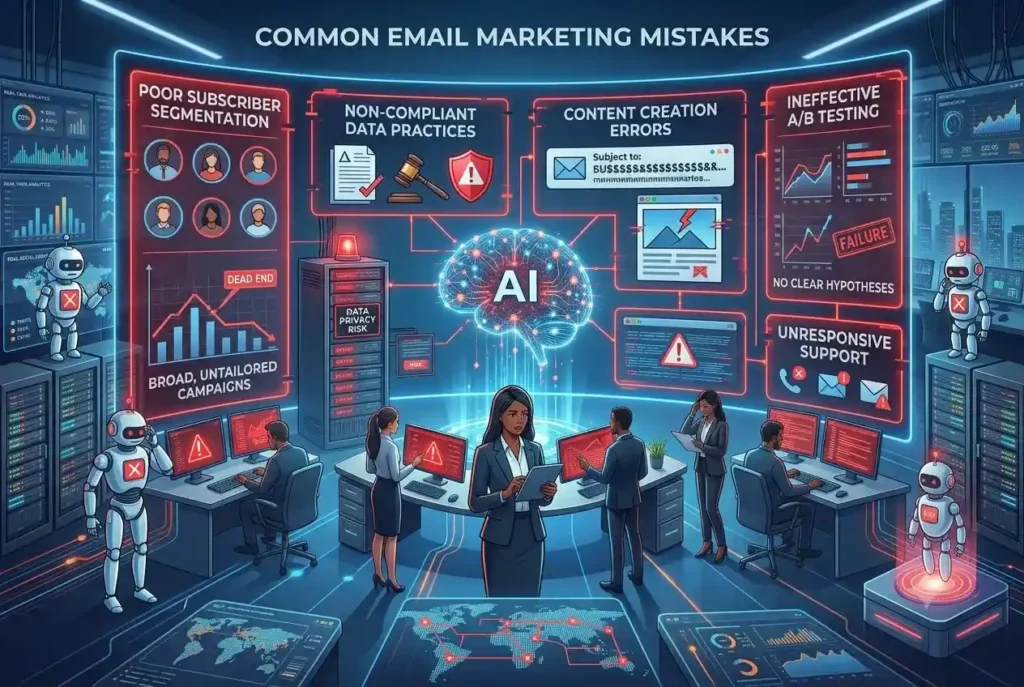
Common Email Marketing Mistakes That Can Harm
Campaign Success
Introduction
Email marketing is one of the most effective digital marketing channels for building customer relationships, increasing engagement, and generating conversions. However, even a well-designed email campaign can fail when businesses make simple but costly mistakes. Sending emails too frequently, using misleading subject lines, relying on overly promotional content, ignoring mobile users, failing to segment subscribers, and using unclear calls to action can significantly reduce campaign performance.
Successful email marketing is not simply about sending a large number of emails. It requires delivering the right message to the right audience at the right time. Businesses must focus on relevance, personalization, permission-based communication, effective list management, and continuous performance analysis. By understanding and avoiding common email marketing mistakes, marketers can improve deliverability, protect their brand reputation, and build stronger relationships with subscribers.
1. Failing to Segment Email Subscribers
One of the most common email marketing mistakes is sending the same generic message to every subscriber. A broad, “batch-and-blast” approach often ignores differences in customer interests, behaviors, purchase history, location, engagement levels, and where they are in the buying journey.
Audience segmentation lets marketers create more relevant, targeted messages. For example, new subscribers may need educational content, while existing customers may respond better to product recommendations, loyalty offers, or personalized updates.
When subscribers consistently receive irrelevant content, they may lose interest, unsubscribe, or mark emails as spam. Effective segmentation therefore improves relevance and increases the likelihood of engagement.
2. Using Weak or Misleading Subject Lines
The subject line is often the first element a subscriber sees. A weak subject line may cause an email to be ignored, even when the content itself is valuable.
Effective subject lines should communicate value, create genuine curiosity, and accurately represent what the email contains. Marketers should avoid deceptive, exaggerated, or overly sensational subject lines simply to increase open rates. Although such tactics may produce short-term results, they can damage customer trust and increase spam complaints.
A strong subject line should create interest while remaining honest and relevant to the recipient.
3. Poor Personalization
Simply including a subscriber’s first name does not necessarily make an email personalized. True personalization means delivering content that is relevant to the individual’s interests, behavior, preferences, or relationship with the brand.
Businesses can use customer data to recommend relevant products, provide personalized offers, acknowledge previous purchases, or deliver content based on browsing and engagement behavior.
When personalization is meaningful rather than superficial, subscribers are more likely to feel that the communication is specifically intended for them.
4. Sending Emails Too Frequently or Too Rarely
Email frequency can have a major impact on campaign performance. Sending too many emails can overwhelm subscribers, causing them to ignore messages or unsubscribe. On the other hand, sending emails too rarely can cause subscribers to forget why they signed up or lose interest in the brand.
The ideal frequency depends on the target audience, industry, campaign objectives, and expectations established when subscribers joined the mailing list.
Businesses should monitor engagement metrics and subscriber feedback to determine an appropriate sending schedule rather than focusing on quantity alone.
5. Focusing Too Much on Selling
Another common mistake is turning every email into a sales message. If subscribers constantly receive emails asking them to purchase something, they may stop paying attention to the brand.
Effective email marketing should provide value in addition to promoting products or services. Businesses can share educational information, useful tips, industry insights, helpful resources, customer stories, or exclusive content.
A balanced content strategy helps build trust and keeps subscribers engaged over the long term.
6. Ignoring Mobile Optimization
A significant number of people read emails on smartphones and tablets. Therefore, emails that are not optimized for mobile devices can quickly lose the attention of subscribers.
Small text, broken images, complicated layouts, excessive scrolling, and buttons that are difficult to tap can create a poor user experience. Businesses should use responsive designs, readable fonts, clear layouts, optimized images, and mobile-friendly calls to action.
Testing emails across different screen sizes and devices can help ensure that the message looks professional and functions correctly.
7. Using Poor-Quality or Purchased Email Lists
Using poor-quality email lists can negatively affect deliverability and sender reputation. Purchased lists are particularly risky because the people included may not have permitted receiving communications from the business.
Permission-based email marketing is more effective because subscribers have actively chosen to hear from the brand. Businesses should build their lists organically and ensure that subscribers understand what type of communication they will receive.
Maintaining a clean database is equally important. Inactive, invalid, or unengaged addresses should be regularly reviewed and managed to protect email deliverability.
8. Neglecting List Hygiene and Inactive Subscribers
Continuing to send emails to subscribers who have not engaged for a long period can negatively affect campaign performance. A large number of inactive recipients may reduce engagement and potentially harm sender reputation.
Instead of repeatedly sending regular campaigns to inactive subscribers, businesses can create re-engagement campaigns. These campaigns can encourage inactive subscribers to reconnect, update their preferences, or confirm whether they still want to receive emails.
If subscribers remain completely inactive, removing or suppressing them from regular campaigns may be a better approach.
9. Creating Unclear Calls to Action
Every marketing email should have a clear purpose. If readers do not understand what they should do after reading the message, valuable engagement can be lost.
Calls to action (CTAs) should be clear, relevant, and easy to identify. Whether the goal is to purchase a product, read an article, register for an event, download a resource, or contact the business, the CTA should guide subscribers toward the intended next step.
Avoiding unnecessary distractions and using one primary CTA can make an email more focused and effective.
10. Ignoring Testing and Analytics
Marketers should not assume that an email will perform well simply because it looks attractive. Testing and analytics are essential for understanding what works for a particular audience.
Businesses can test different subject lines, content structures, images, calls to action, personalization methods, and sending times. A/B testing can help identify which variations generate stronger results.
Important metrics include open rates, click-through rates, conversions, bounce rates, unsubscribe rates, and revenue generated. Measuring these indicators provides a clearer picture of campaign effectiveness than simply counting the number of emails sent.
11. Making Emails Too Long or Difficult to Read
Email subscribers often scan their inboxes. Long paragraphs, excessive information, cluttered layouts, and unclear messaging can make an email difficult to understand.
Email content should be concise, organized, and easy to scan. Headings, short paragraphs, bullet points, relevant images, and clear CTAs can improve readability.
The main message should be immediately understandable, with additional information provided only when it adds value.
12. Ignoring Data Privacy and Compliance
Email marketing must also follow applicable privacy and communication regulations. Businesses should understand relevant requirements, such as the GDPR, CAN-SPAM Act, and California Consumer Privacy Act, where applicable to their activities and audience.
Hiding unsubscribe options, sending emails without appropriate permission, or purchasing third-party lists can create legal and reputational risks.
Providing an easy unsubscribe option and respecting subscribers’ communication preferences demonstrates professionalism and gives customers control over their relationship with the brand.
Conclusion
Successful email marketing is not about sending the largest possible number of emails. It is about delivering the right message to the right person at the right time.
Businesses can significantly improve their email marketing performance by avoiding common mistakes such as poor segmentation, weak or misleading subject lines, excessive promotional content, ineffective personalization, poor mobile design, unclear calls to action, unhealthy email lists, inadequate testing, and failure to respect subscriber preferences.
A strong email marketing strategy should be permission-based, relevant, valuable, personalized, and data-driven. When businesses focus on providing genuine value rather than simply increasing the number of emails they send, they can improve engagement, strengthen customer trust, protect their sender reputation, and generate sustainable long-term results.