
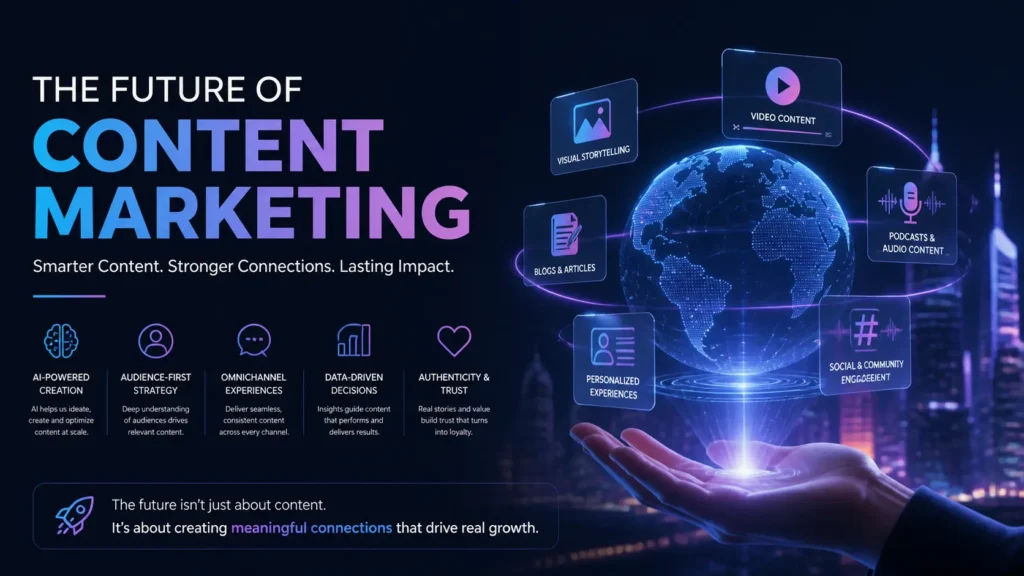
The Future of Content Marketing: From Content Creation to Intelligent Audience Experiences
Introduction
Content marketing is entering a period of significant transformation. As brands gain access to increasingly sophisticated creative tools, automation, analytics, and artificial intelligence (AI), the ability to produce content at scale is becoming easier than ever. However, this increased accessibility also means that the digital environment will become more competitive and saturated.
In the future, simply producing a large volume of content will no longer be enough to attract and retain audiences. Marketers will need to focus on originality, strong storytelling, useful research, authentic experiences, personalization, and community engagement. The future of content marketing will therefore be defined by a shift from mass content production toward human authenticity, intelligent AI-powered scaling, hyper-personalization, and multi-platform visibility.
The Rise of Generative Engine Optimization (GEO)
One of the most important changes in content marketing will be the evolution of search. As search engines increasingly incorporate generative AI and AI-powered answers, traditional Search Engine Optimization (SEO) is evolving toward Generative Engine Optimization (GEO).
In traditional SEO, marketers primarily focus on ranking webpages for specific keywords. In generative search environments, visibility will increasingly depend on whether a brand’s content is considered reliable and useful enough to be referenced or cited directly by AI systems.
This change means that content marketers will need to think beyond keyword rankings. Content should provide clear answers, original insights, credible information, strong expertise, and valuable context that AI systems can understand and reference. As a result, creating genuinely useful and authoritative content will become more important than simply optimizing content for search algorithms.
Artificial Intelligence as the Backbone of Content Marketing
AI will play a central role in the future of content marketing. It can support marketers with data analysis, audience segmentation, behavioral insights, content creation, personalization, automation, and content distribution.
AI-powered systems can analyze customer behavior in real time and identify patterns that would be difficult to detect manually. These insights can help brands understand what different audience groups need and deliver more relevant content at the right stage of the customer journey.
However, AI should not replace human creativity. Instead, automation can free marketers from repetitive tasks and allow them to concentrate on higher-value activities such as strategic planning, deep research, authentic storytelling, creative direction, and emotional communication. Human judgment and creativity will remain essential because audiences are more likely to connect with content that demonstrates genuine understanding, personality, and experience.
The Expansion of Multi-Platform and Multi-Format Content
Content marketing will also move beyond traditional blog articles and static webpages toward broader, multi-format content ecosystems. Short-form video will remain an important format because platforms such as Instagram, YouTube, and TikTok have demonstrated the effectiveness of concise and visually engaging storytelling.
At the same time, long-form articles, podcasts, newsletters, webinars, detailed guides, and educational resources will continue to play an important role in developing authority and trust.
The key opportunity will be to connect these formats rather than treating them as separate pieces of content. A single strong idea could be transformed into a blog article, short-form video, carousel, podcast discussion, newsletter, infographic, and social media post. This approach allows brands to reach audiences across different platforms while maintaining a consistent message without simply repeating the same content.
Personalization and Intelligent Audience Experiences
Personalization will become another defining characteristic of future content marketing. Instead of delivering the same message to every customer, brands will increasingly use data and technology to create experiences based on individual interests, behavior, location, previous interactions, and position within the buying journey.
This could allow different customers to receive different content depending on their needs and preferences. For example, a new visitor may receive educational content, while an existing customer may receive advanced product information, personalized recommendations, or loyalty-focused communication.
The objective will be to make content feel more relevant and meaningful to each individual rather than treating the entire audience as a single group.
The Growth of Interactive Content
Future content marketing will also become increasingly interactive. Rather than simply consuming information, audiences will be encouraged to participate in the content experience.
Interactive formats may include quizzes, calculators, polls, assessments, interactive videos, virtual experiences, and AI-powered conversations. These formats can increase engagement while also helping brands understand their audiences more effectively.
Interactive content can therefore create a two-way relationship between brands and customers. Instead of simply communicating a message, brands can use content to encourage participation, collect insights, answer questions, and create memorable experiences.
Authenticity and Human-Centered Storytelling
As AI makes it easier to produce large amounts of content, authenticity will become increasingly valuable. Audiences are becoming better at recognizing content that feels artificial, overly promotional, generic, or mass-produced.
Brands that share real experiences, behind-the-scenes stories, customer perspectives, expert opinions, original research, and transparent communication will have greater opportunities to build credibility and trust.
Human-centered storytelling will therefore become a major competitive advantage. While AI can assist with generating and distributing information, genuine experiences, emotions, opinions, and personal perspectives are difficult to replicate convincingly. Brands that demonstrate a real understanding of their customers will be better positioned to create meaningful relationships.
The Increasing Importance of Community-Driven Content
Community-driven content will also play a larger role in the future. Customers increasingly look for recommendations, reviews, discussions, experiences, and opinions from real people rather than relying exclusively on brand-created messages.
User-generated content, customer stories, online communities, reviews, expert discussions, and social conversations can provide a sense of authenticity that traditional advertising often cannot achieve.
This means brands will need to move from simply speaking to their audiences toward actively building communities with them. Strong communities can become valuable sources of trust, feedback, advocacy, and long-term customer relationships.
From Campaign-Based Marketing to Always-On Engagement
Content marketing will gradually shift from a campaign-based approach toward an always-on relationship-building strategy. Instead of communicating with audiences only during specific campaigns or promotional periods, brands will continuously educate, entertain, inform, and engage their customers.
This approach recognizes that customer relationships develop over time. Consistent and valuable communication can help brands remain relevant throughout the entire customer journey, from initial awareness to purchase, retention, advocacy, and repeat engagement.
The Evolution of Content Marketing Measurement
Measurement will evolve alongside these changes. Traditional metrics such as impressions, likes, shares, and page views will continue to provide useful information, but they will no longer be sufficient to evaluate the true impact of content marketing.
Marketers will increasingly focus on deeper indicators such as engagement quality, qualified leads, conversions, customer retention, brand trust, customer lifetime value, and revenue contribution.
The important question will no longer be simply “How many people saw this content?” Instead, marketers will need to understand “What happened after people consumed this content?”
This shift will encourage businesses to connect content performance with meaningful business outcomes and customer behavior.
The Growing Value of Original Expertise and First-Hand Experience
Another major trend will be the increasing importance of original expertise and first-hand experience. As AI makes it easier to produce large quantities of generic information, content that offers something genuinely unique will become more valuable.
Original research, expert knowledge, personal experiences, unique data, practical insights, case studies, and strong points of view can differentiate a brand from competitors producing similar AI-generated material.
In an increasingly crowded digital environment, audiences will have less reason to engage with content that simply repeats information they can find elsewhere. Content marketers will therefore need to provide perspectives, experiences, and insights that audiences cannot easily obtain from generic sources.
The Changing Role of the Content Marketer
These developments will fundamentally change the role of the content marketer. Marketers will need to become more than content producers. They will increasingly act as strategists, storytellers, researchers, analysts, community builders, and brand architects.
Their role will involve understanding audience behavior, identifying meaningful topics, developing strong ideas, using AI intelligently, selecting the right platforms, measuring outcomes, and maintaining a consistent brand identity.
The most successful marketers will likely be those who understand how to combine technological capabilities with distinctly human qualities such as creativity, critical thinking, empathy, originality, and emotional intelligence.
Conclusion
The future of content marketing will not be defined by the ability to create more content. Instead, it will be defined by the ability to create better, more relevant, authentic, and meaningful content.
AI, automation, generative search, personalization, interactive experiences, multi-platform distribution, and advanced analytics will fundamentally reshape how brands communicate with their audiences. However, technology alone will not guarantee success. Human creativity, original expertise, authentic storytelling, and genuine audience understanding will remain essential.
Ultimately, the future of content marketing will be about creating an intelligent and interconnected content ecosystem in which technology handles scale and efficiency while people provide creativity, experience, emotion, and strategic direction. Brands that successfully combine these capabilities will be better positioned not only to attract attention but also to build trust, create memorable experiences, develop communities, and establish lasting relationships with their audiences.