
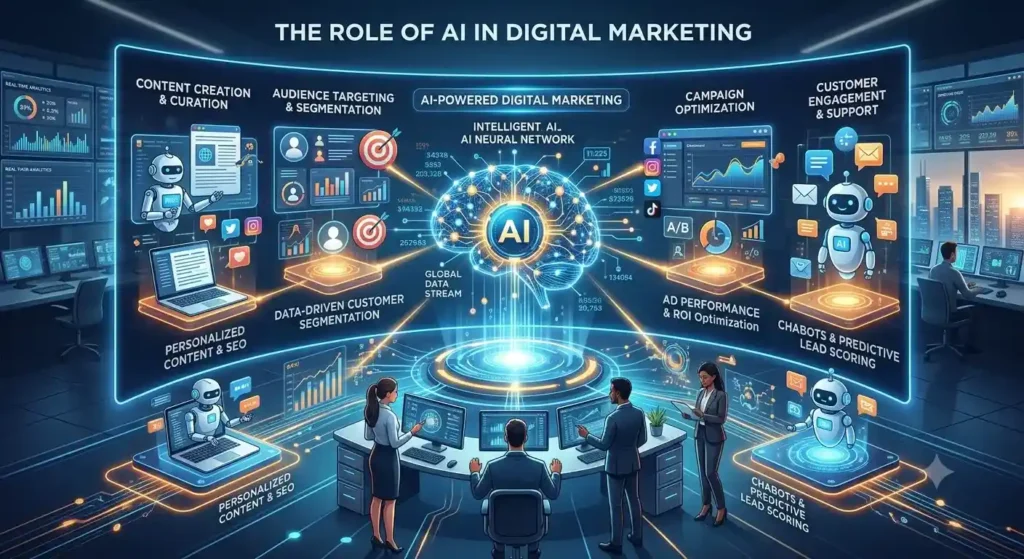
The Role of AI in Digital Marketing: Transforming Strategy, Personalization, and Growth
Introduction
Artificial Intelligence (AI) has become one of the most influential technologies shaping modern digital marketing. From understanding customer behavior and generating content to optimizing advertising campaigns and automating communication, AI has transformed marketing from a largely manual and reactive process into a more proactive, data-driven, and personalized ecosystem.
AI enables marketers to process enormous amounts of data, identify patterns, predict customer behavior, automate repetitive tasks, and make faster, more informed decisions. It can support almost every stage of the marketing process, including research, content creation, search engine optimization (SEO), social media marketing, paid advertising, customer service, email marketing, and campaign optimization.
However, AI does not eliminate the need for human marketers. Instead, it changes the way they work. While AI can process information and perform repetitive tasks at remarkable speed, human creativity, strategic thinking, empathy, originality, and ethical judgment remain essential. The most successful marketers will therefore be those who know how to combine the capabilities of AI with human expertise.
How AI Is Transforming Digital Marketing
Artificial Intelligence has fundamentally changed the way businesses understand their audiences and interact with customers. Instead of relying entirely on assumptions or manual research, marketers can use AI to analyze vast amounts of consumer information, including browsing behavior, purchase history, search activity, engagement patterns, and social media interactions.
This allows businesses to identify customer preferences, understand market trends, and make data-driven decisions in real time. AI-powered systems can also help marketers predict what customers may want next, creating opportunities for more relevant communication and improved customer experiences.
AI-Powered Personalization
One of the most significant contributions of AI to digital marketing is personalization. Modern consumers expect brands to provide experiences that are relevant to their interests and needs.
AI can analyze customer data and use those insights to deliver personalized product recommendations, emails, advertisements, website experiences, and social media content. For example, businesses can segment audiences based on their behavior and interests and provide different messages or offers to different customer groups.
Personalization not only improves the customer experience but can also increase engagement, conversions, and long-term customer loyalty.
AI in Content Marketing
AI is also transforming the content marketing process. Marketers can use AI tools to generate ideas, research topics, identify trends, create initial drafts, develop headlines, and adapt content for different platforms.
AI can significantly reduce the time required for repetitive content-related tasks and help marketers produce multiple variations of marketing materials. However, effective content still requires human involvement.
Human marketers provide storytelling, originality, emotional intelligence, brand personality, and strategic direction. AI-generated content without human review can become repetitive, generic, inaccurate, or disconnected from the brand’s identity. Therefore, the most effective approach is to use AI as a creative assistant rather than a complete replacement for human creativity.
AI and Search Engine Optimization
Artificial Intelligence is playing an increasingly important role in Search Engine Optimization (SEO). AI-powered tools can help marketers discover keyword opportunities, analyze search intent, research competitors, organize content topics, identify optimization opportunities, and monitor changes in search behavior.
AI can also help marketers understand the questions and topics audiences are interested in, allowing businesses to create content that better satisfies user needs.
As search continues to evolve through technologies such as voice search, visual search, and AI-powered search experiences, marketers need to focus not only on keywords but also on relevance, usefulness, search intent, and the overall quality of their content.
AI in Social Media Marketing
Social media marketing is another area where AI provides significant advantages. AI can analyze engagement data, identify trending topics, suggest content ideas, assist with caption creation, and help marketers understand which types of posts generate the strongest responses.
By analyzing historical performance, AI can help marketers identify patterns in audience behavior and make better decisions about content strategies. This allows marketing teams to spend less time analyzing large volumes of data manually and more time developing creative campaigns and meaningful audience relationships.
AI-Powered Customer Service and Chatbots
AI-powered chatbots and conversational systems are changing how businesses communicate with customers. Intelligent virtual assistants can answer frequently asked questions, provide product information, guide customers through services, and offer support at any time of the day.
This 24/7 availability can improve customer satisfaction while reducing the workload associated with repetitive customer service requests. In some cases, AI-powered conversations can also guide potential customers toward suitable products or services, turning customer interactions into potential conversion opportunities.
However, businesses should recognize when human support is necessary. Complex, sensitive, or highly personalized customer issues may still require human assistance.
AI in Paid Advertising and Campaign Optimization
Paid advertising has also benefited significantly from Artificial Intelligence and machine learning. AI can analyze campaign performance and help marketers optimize audiences, budgets, bidding strategies, advertising placements, and creative variations.
Programmatic advertising systems can make decisions in real time based on available data, helping businesses reach relevant audiences more efficiently. AI can continuously learn from campaign results and identify which strategies are producing better outcomes.
As a result, marketers can potentially improve return on investment (ROI) while reducing the amount of manual work required to monitor and optimize advertising campaigns.
Predictive Analytics and Customer Behavior
Predictive analytics is one of the most powerful applications of AI in digital marketing. Instead of simply analyzing what happened in the past, AI can help marketers anticipate future customer behavior.
For example, AI systems can identify customers who may be likely to make a purchase, stop engaging with a brand, or respond positively to a particular offer. These insights allow marketers to take action before a customer makes their next move.
Predictive analytics can also support customer retention strategies and help businesses understand potential customer lifetime value, making marketing decisions more proactive and strategic.
AI in Email Marketing
Email marketing can also become more effective through AI-driven personalization and automation. AI can assist with audience segmentation, personalized subject lines, recommended sending times, behavioral triggers, and customized email content.
For example, a business can use customer behavior to determine which products or services should be promoted to specific individuals. Automated systems can then deliver relevant messages based on customer actions, interests, and engagement patterns.
This allows businesses to move beyond generic mass emails and create more targeted communication.
Challenges and Ethical Considerations
Although AI offers significant advantages, marketers must also recognize its limitations and risks. Data privacy is an important concern because AI systems often rely on large amounts of customer information. Businesses must ensure that customer data is collected, stored, and used responsibly.
Other challenges include inaccurate or misleading AI-generated information, algorithmic bias, over-automation, lack of originality, and the production of generic content when human oversight is missing.
Marketers must therefore use AI responsibly and maintain appropriate human oversight. Ethical data practices, transparency, accuracy, and respect for customers should remain central to every AI-powered marketing strategy.
The Future of AI in Digital Marketing
The future of digital marketing will not simply belong to businesses that use the most Artificial Intelligence. Instead, it will belong to marketers who know how to use AI strategically and responsibly.
AI can process enormous amounts of information, identify patterns, automate workflows, and support faster decision-making. Humans, however, provide the purpose and context behind those decisions. Creativity, empathy, strategic thinking, brand understanding, and ethical judgment cannot simply be replaced by automation.
As digital competition continues to increase, marketers who develop strong AI skills will be better positioned to understand their audiences, personalize customer experiences, improve efficiency, and make smarter marketing decisions.
Conclusion
Artificial Intelligence is no longer simply an additional software tool for digital marketers. It is becoming a fundamental technology that is reshaping how businesses attract audiences, create content, optimize campaigns, communicate with customers, and achieve long-term growth.
From personalization and predictive analytics to SEO, social media, paid advertising, email marketing, and customer service, AI has become an important part of the modern marketer’s toolkit. Its greatest value lies not in replacing human marketers but in helping them work more efficiently and make better-informed decisions.
The future of digital marketing will therefore depend on a balance between artificial intelligence and human intelligence. AI can provide speed, scale, and data-driven insights, while humans bring creativity, empathy, strategy, and purpose. Marketers who successfully combine these strengths will be better equipped to build meaningful customer relationships and create sustainable growth in an increasingly AI-driven digital world.